A local-first product showcase for S&OP demand, BOM coverage, inventory, capacity, policy signals, release governance and agent-readable decision evidence.
synthetic product families
BOM and stock records
4-week demand baseline
official-source signals
domain and API checks
tagged GitHub release
The dashboard is generated from deterministic backend functions. The showcase leads with the actual control tower, then explains the gates, data spine and adapter boundaries behind it.
The page now reads like a product system: each module owns a real workflow, a data contract and a reason to exist in the control tower.
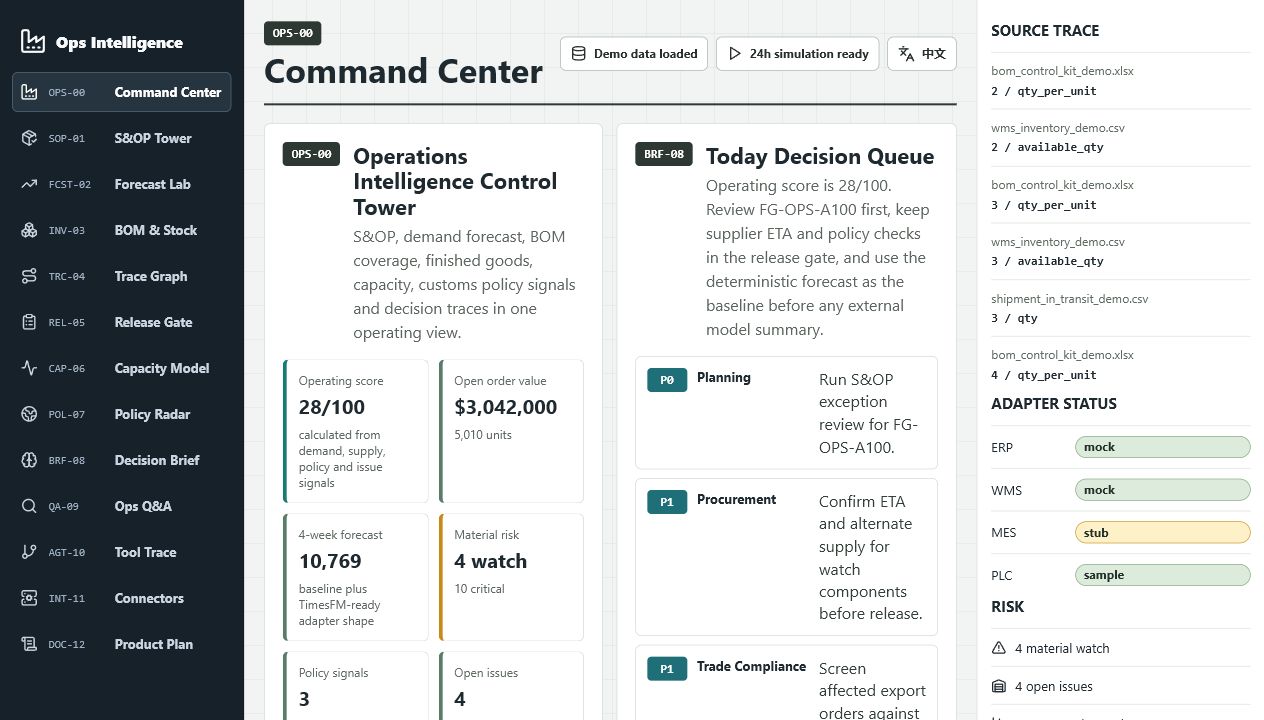
Portfolio health, open order value, demand forecast, material risk, policy signals and issue queue.
Deterministic baseline today, TimesFM-ready series contract for future model adapters.
Official-source customs and policy signals linked to materials, products and open orders.
Natural-language questions route through deterministic tools before any model-ready summary.
24h line simulation with bottleneck, utilization, waiting and blocking metrics.
Inspired by enterprise operations platforms, the demo makes approval state visible instead of implying that an agent can silently release production or shipment work.
2 checks pass, 3 need review, 1 waits for human approval. The package keeps owner action and evidence attached.
BOM demand and WMS stock coverage with source rows.
Order quantity checked against simulated weekly capacity.
Customs and policy signals linked to affected materials.
Quality bottleneck and serialized controls stay visible.
BOM, stock, inbound and supplier evidence attached.
Final export remains behind an operations owner.
Top operations products sell portability. The showcase now makes that explicit: profiles define users, sources, controls and decision loops without private project data.
Demand -> material gate -> capacity -> release -> trace.
Order promise -> pick readiness -> carrier plan -> shipment release.
Service demand -> kit completeness -> vendor ETA -> dispatch gate.
Sample intake -> test capacity -> hold decision -> release evidence.
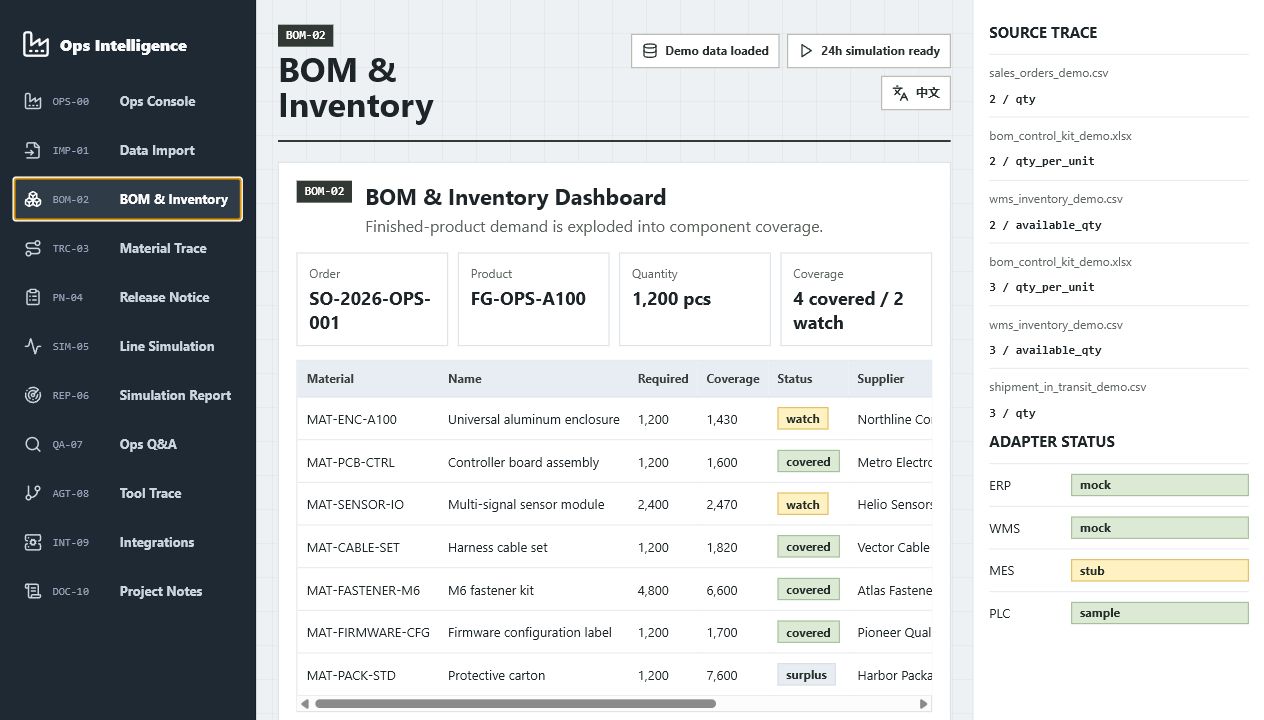
The screenshots are not decorative thumbnails. They prove the product has concrete screens for planning, material risk, release governance, traceability and capacity analysis.

Component demand, stock coverage, supplier context and source refs.

Notice export context with gate decision attached.

Product, BOM, stock, inbound and supplier evidence chain.

Machine states, output, utilization, blocking and bottleneck evidence.
The repo is public-safe by construction: synthetic records, deterministic calculations, explicit adapter modes and generated UI snapshots.
Generic JSON records with source-row references.
Repeatable local state for API demos and tests.
Forecast, material, policy, release and simulation logic.
Bounded routes for products, gates, profiles and agents.
Frontend can render without a live private factory system.
Tool calls, inputs and evidence stay inspectable.
The page now surfaces the trust signals a reviewer expects from a serious public engineering project.
Seed, snapshot, self-check, pytest, smoke demo, tone scan and web build.
No credentials or private factory files. API inputs are bounded and CORS is local-only.
TimesFM and LLMs are adapter boundaries, not hidden truth sources.
Forecast backtesting, policy adapters, security posture and visual regression remain tracked.